Blog
Cornish Cross Week by Week Guide (with pictures)
Whether you’re raising your first batch or have years of experience, a week-by-week guide can help you track your Cornish Cross as they grow. This guide includes weekly weight ranges, photos, feeding information, and practical tips from placement through processing age.
Ask the hatchery
Myers Poultry has worked with Cornish Cross chickens for more than 30 years. If you have questions while you raise your own, contact us at info@myerspoultry.com or 814-839-7026.
By week 9, the average Cornish Cross will eat 15.7 lbs of food in its lifetime. Check out our Cornish Cross feed calculator to see how much feed your flock will need.
Cornish Cross Week-By-Week Growth Chart
Above are average live weights and feed consumption based on optimally raised Cornish Cross. Individual birds will vary, especially in straight run flocks where males generally grow larger than females. Use this chart as a guide, but check the size, mobility, and body condition of your own birds as they grow.
Check out the full Cornish Cross feed conversion chart for weekly and daily feed amounts, total feed eaten, average live weights, and feed conversion ratios from hatch through processing.
Before Your Chicks Arrive
Have the brooder warm and ready before your chicks arrive. Set up fresh bedding, chick starter feed, and clean water, then check that the heat source is working properly and the brooder is free from drafts.It also helps to purchase your feed ahead of time. By Week 9, the average Cornish Cross will have eaten about 15.7 pounds of feed. Use our Cornish Cross feed calculator to estimate how much feed your flock will need based on your number of chicks and planned processing week.
Day One
After their trip, the chicks will be thirsty, hungry, and ready to settle in. They will still be covered in soft down and weigh only a couple of ounces, but they will begin eating, drinking, and exploring the brooder once they are comfortable.Average weight (straight run): 0.12 lb
Feeding Information: 24-22% protein starter feed with 24/7 access
Comfortable temperature range: 95°F directly underneath heat lamp
What to do this week: Show chicks where feed and water is, and watch their behavior. Their behavior will help you decide whether the brooder temperature needs adjusted. If using a brooder plate, be sure that th etemperature in the rest of the brooder does not go below 65°F.
Week 1
The chicks will begin growing their first wing feathers while the rest of their bodies remain mostly covered in down. They are still small, active, and quick to gather around fresh feed and water.
Average weigh (straight run): 0.45 lb
Feeding Information: 24-22% protein starter feed, with 24/7 access
Comfortable temperature range: 95° F directly underneath heat lamp
What to do this week: Keep the brooder warm, dry, and free from temperature swings and drafts. Feeders and waterers can become dirty quickly, so clean and refill them as needed.
Week 2
By the end of Week 2, most chicks will weigh around one pound. Their bodies will look rounder and more filled out, and new feathers will continue developing along their wings, body, and tail.Average weight (straight run): 1.1 lb
Feeding Information: 24-22% protein starter feed, with 12 hour access
Comfortable Temperature Range: 90° F directly underneath heat lamp
What to Do This Week: Start a 12-hours-on, 12-hours-off feeding schedule. The chicks will become noticeably bigger and more active this week.
Week 3
Growth becomes much more noticeable this week, with many chicks gaining close to a pound. Their bodies begin to look broader, and they may start appearing crowded in a brooder that felt roomy just a week earlier.
Average weight (straight run): 2.1 lb
Feeding Information: 22-20% protein grower feed, 12 hour access
Comfortable Temperature Range: 85° F directly underneath heat lamp
What to Do This Week: If you are using a 24% protein feed, now is the time to reduce to 22-20% protein. By Week 3, your birds may start outgrowing their original brooder setup.
Extend the brooder if needed, and raise the feeders and waterers to help keep bedding out of them. If you plan to move your Cornish Cross outdoors, start preparing their pasture shelter or outdoor space now.
Folks in warmer climates may be able to move their Cornish Cross outdoors this week.
Week 4
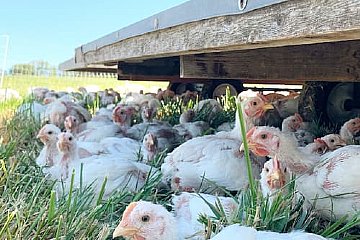
By Week 4, the chicks are feathering out and beginning to take on the broad, heavy shape Cornish Cross are known for. Many flocks are ready to move outdoors around this age when the birds are well feathered and the weather is mild.Average weight (straight run): 3.4 lb
Feeding Information: 18-19.5% protein* finisher feed, 12 hour access
Comfortable Temperature Range: 65°-80°F
What to Do This Week: Some flocks are ready to move outdoors around Week 4, but feather development and weather matter more than the calendar.
Choose a stretch of mild, dry weather and make sure the birds have shelter, shade, and protection from predators. Continue watching for any bird that appears weak or begins falling behind the flock.
*Although we suggest 18-19.5% feed for optimal growth, it may be hard to find. Many people have used 22% feed for the entire life of the Cornish Cross successfully.
Week 5
The birds will continue filling out through the chest and body this week. In a straight-run flock, the size difference between males and females may also become easier to see.Average weight (straight run): 4.8 lb
Feeding Information: 18-19.5% protein* finisher feed, 12 hour access
Comfortable Temperature Range: 65°-80°F
What to Do This Week: By now, the birds are growing quickly, and you will probably notice more manure production. Keep their shelter dry, provide plenty of shade, and move or clean the area as needed.
*See week 4 footnote.
Week 6
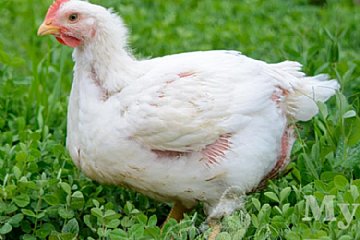
By Week 6, Cornish Cross have developed a wide breast and a noticeably heavier frame. They will spend more time resting between trips to the feeder and waterer, but they should still be able to stand and move around comfortably.Average weight (straight run): 6.3 lb
Feeding Information: 18-19.5% protein* finisher feed, 12 hour access
Comfortable Temperature Range: 65°-80°F
What to Do This Week: Feed and water disappear much faster at this age. If the birds are crowding around the feeders or waterers, add more so the entire flock has access.
Watch how each bird moves, and pay attention to any bird that struggles to walk or keep up with the group.
*See week 4 footnote.
Week 7
Many Cornish Cross are approaching processing size by Week 7. The birds will feel solid and heavy, and differences in size across a straight-run flock will be more noticeable.Average weight (straight run): 7.7 lb
Calculated Dressed Weight: 5.39 lb
Feeding Information: 18-19.5% protein* finisher feed, 12 hour access
Comfortable temperature range: 65°-80°F
What to Do This Week: Your Cornish Cross are getting close to processing size, so this is a good week to weigh a few birds and see how the flock is progressing.
If you have not already confirmed your processing plans, now is the time to do it.
*See week 4 footnote.
Week 8
By Week 8, many Cornish Cross have reached a common processing size. Their breasts are broad, their bodies are well filled out, and the largest birds may be ready for the freezer.Average weight (straight run): 9 lb
Calculated Dressed Weight: 6.3 lb
Feeding Information: 18-19.5% protein* finisher feed, 12 hour access
Comfortable temperature range: 65°-80°F
What to Do This Week: Many Cornish Cross are ready to process around Week 8, but the right timing depends on your preferred finished size.
Weigh birds from different parts of the flock instead of judging them by sight alone. Some people choose to process the largest birds first and give the smaller ones more time to grow.
*See week 4 footnote.
Cornish Cross - 8 weeks old
Dressed Cornish Cross at 8 weeks
Week 9
Birds kept through Week 9 will continue gaining weight and filling out. At this size, differences in body condition become easier to notice, especially between the largest and smallest birds in the flock.Average weight (straight run): 9.8 lb
Calculated Dressed Weight: 6.9 lb
Feeding Information: 18-19.5% protein* finisher feed, 12 hour access
Comfortable temperature range: 65°-80°F
What to Do This Week: If you are still growing your birds, continue checking their mobility and overall condition each day.
Process the birds that have reached your target size, and make sure those remaining can comfortably reach feed and water.
Keep a close eye on the weather, especially during periods of heat.
*See week 4 footnote.
Week 10
While Cornish Cross can be grown past week 9, it needs to be done in a controlled way, with close attention on feeding schedules, weather, and bird health. Being able to grow birds out to week 10 requires careful attention starting on day 1.Average weight (straight run): 10.8 lb
Calculated Dressed Weight: 7.6 lb
Feeding Information: 18-19.5% protein* finisher feed, 12 hour access
Comfortable temperature range: 65°-80°F
What to Do This Week: By Week 10, most Cornish Cross should be ready for processing.
Continue the same feeding routine and watch the remaining birds closely while you finish your plans.
Avoid extending the grow-out simply to reach a larger weight if mobility, body condition, or hot weather becomes a concern.
*See week 4 footnote.